
Yombe · Democratic Republic of the Congo
Yombe · 20th century, probably mid to late
| Dimensions | Height 32.5 cm (12¾ in)Width 14 cm (5½ in)Depth 10 cm (3⅞ in) |
|---|---|
| Country | Democratic Republic of the Congo / Republic of the Congo / AngolaMore about CountryThe Kongo cultural region covers the western Democratic Republic of the Congo (Kongo Central), the Republic of Congo and northern Angola, with the Mayombe forest belt as the heartland of nail figures. |
| Tribe / Culture | YombeMore about Tribe / CultureThe figure is attributed to the Kongo (Bakongo) peoples, whose historical range runs from the Atlantic coast inland along the lower Congo River. Within this world, the Yombe and Vili of the coastal hinterland (Mayombe) are the sub-groups most closely associated with nkisi nkondi, the nail-studded power figure. Their sculptors favoured a refined, near-naturalistic face with inset eyes, set above a body built up with ritual materials. This piece sits within that canon, and a Yombe-style attribution is the most appropriate working label. |
| Age / Period | 20th century, probably mid to lateMore about Age / PeriodThe tradition's classic period is the mid-19th to early 20th century, roughly the 1850s–1930s. Collectors and scholars regard it as the high point of Kongo power-figure sculpture. On visual grounds, this example is more securely placed in the 20th century, probably mid to late. Its formal vocabulary is that of the classic tradition. Its dating has not been established by any documentary or scientific evidence. |
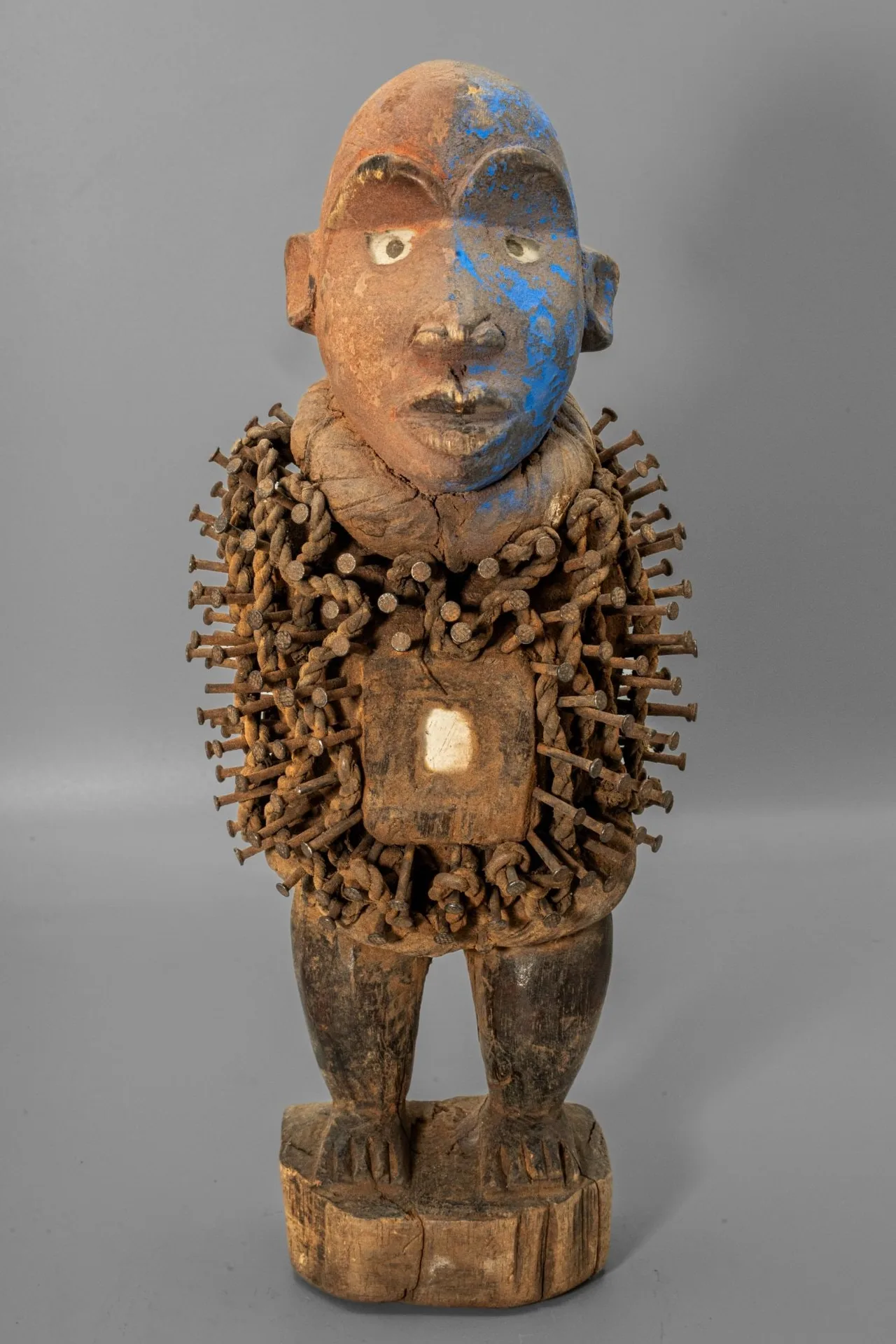
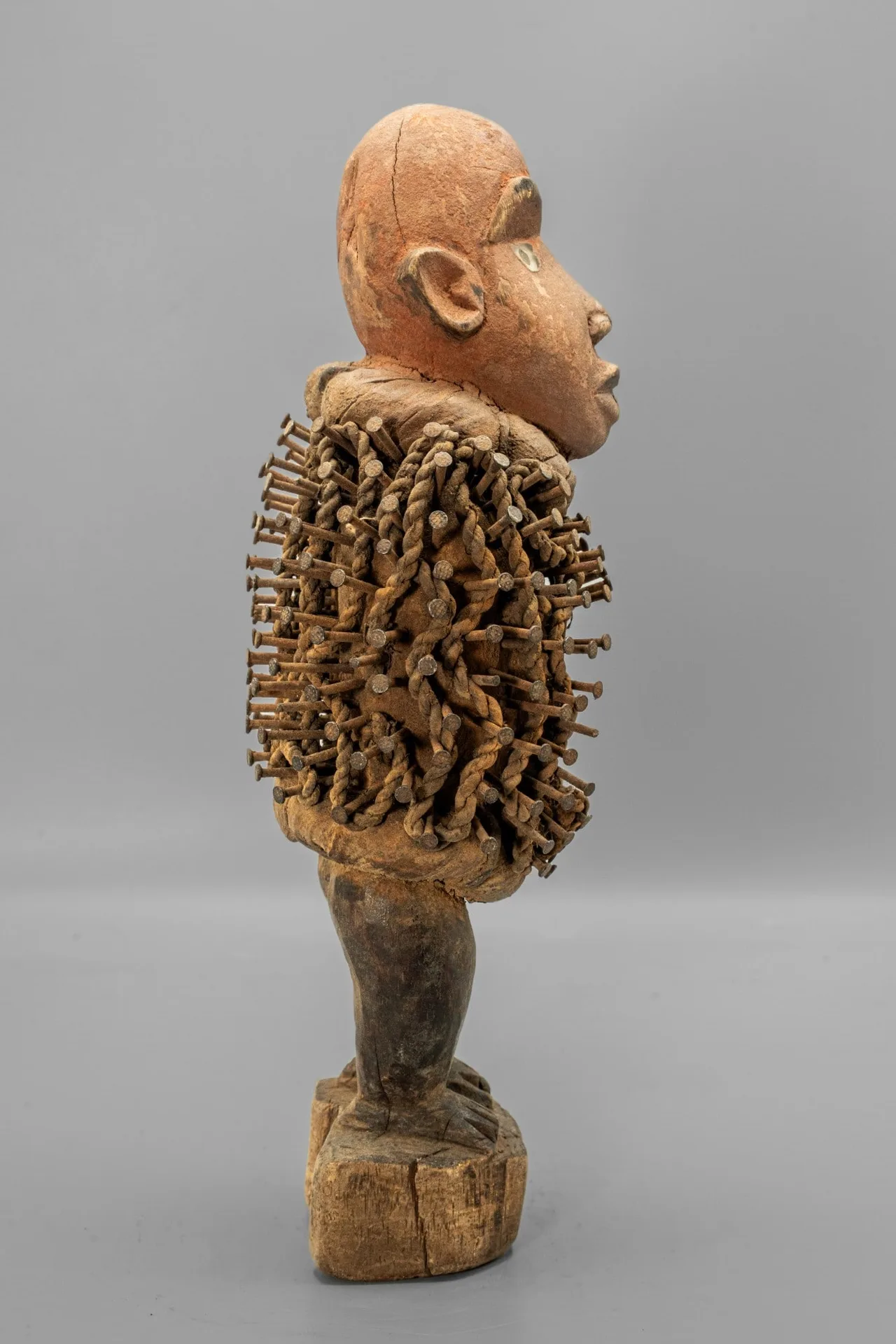
In Kongo cosmology, a nkisi is a vessel for a spirit, activated by a ritual specialist (nganga). The nkondi type is the hunter or enforcer, summoned to seal oaths, settle disputes and pursue wrongdoers. Each nail or blade driven into the body records an invocation, such as a pact made, a grievance lodged or a protection sought. Hence the dense, accumulated surface.
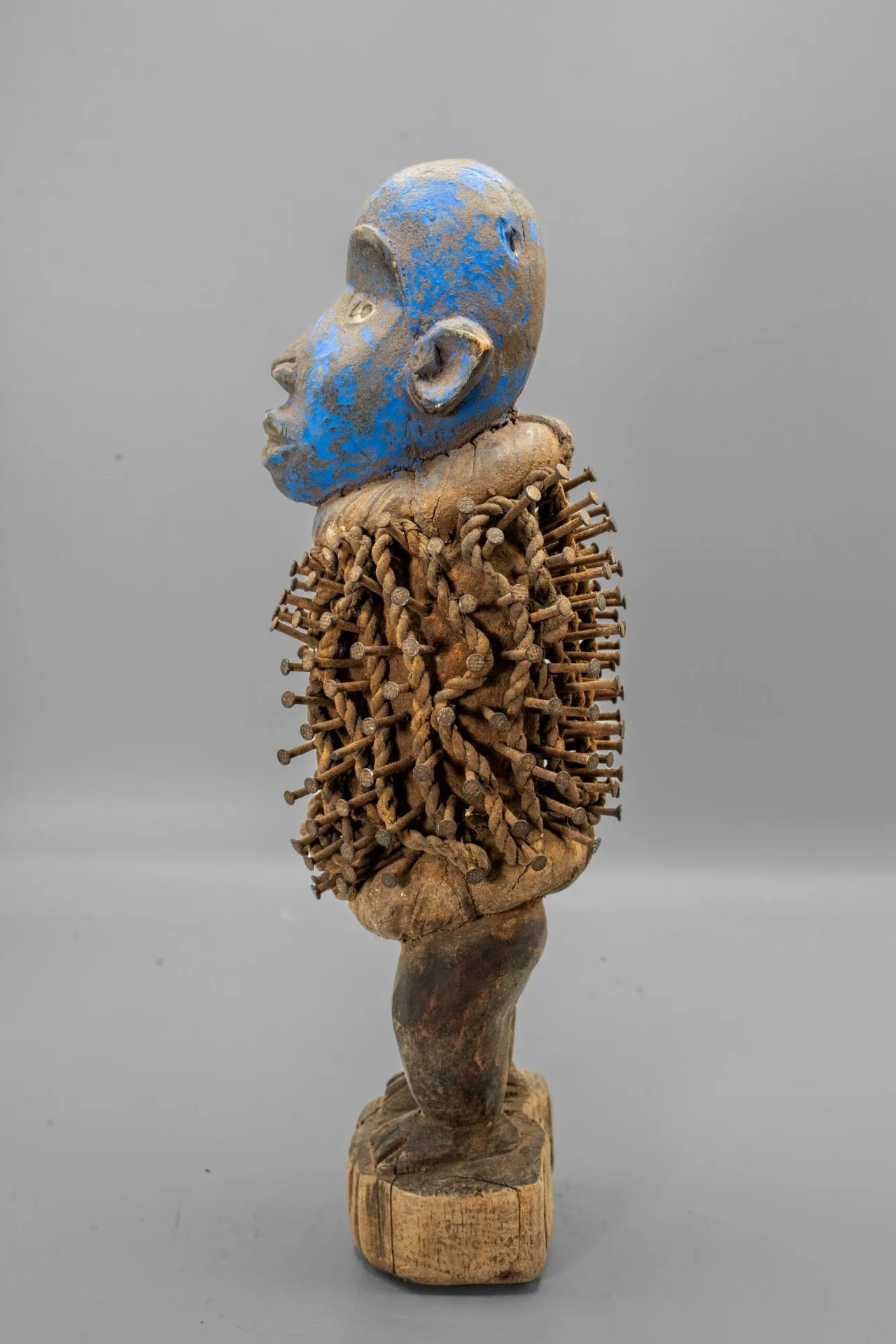
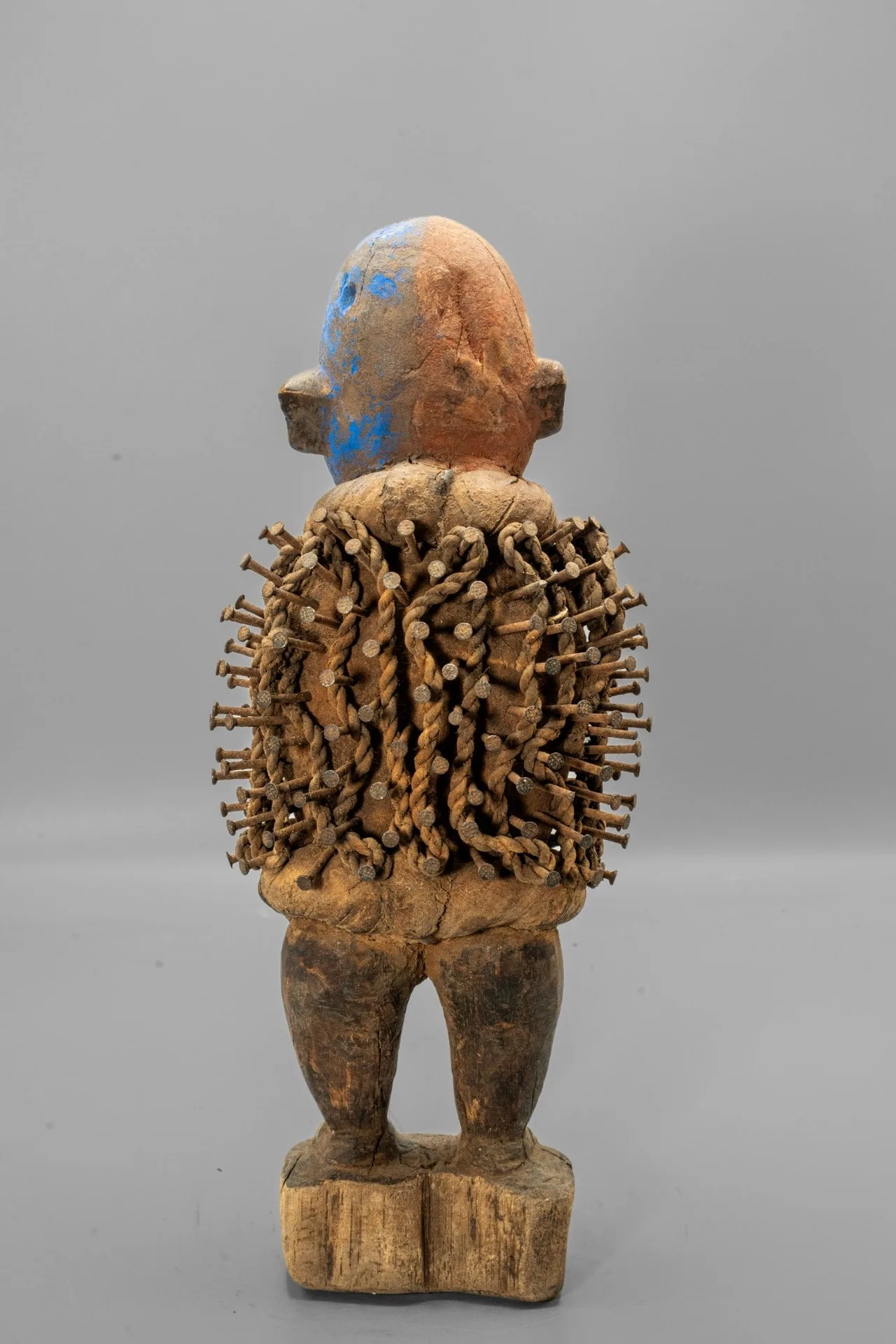
The rectangular plaque at the belly with its white inset is the position of the “medicine” cavity. This is where the bilongo, the empowering substances, were sealed behind a reflective or pale cover. The twisted fibre cords bind and contain that force. The cavity at the crown of the head is a recognised receptacle for further medicines.
The half-red, half-blue face reflects the Kongo use of colour as spiritual language. Red ochre (tukula) is linked to power, transition and the spirit world, and white with blue is used for the realm of the dead and clairvoyance. The inset eyes give the figure the direct, watchful gaze that “sees” wrongdoing.
The figure has a strong frontal presence. The smooth, domed head and calm, serene features contrast with the bristling armature of nails and twisted cord at the torso. This tension between stillness and accumulated force is the quality collectors most value in the genre.
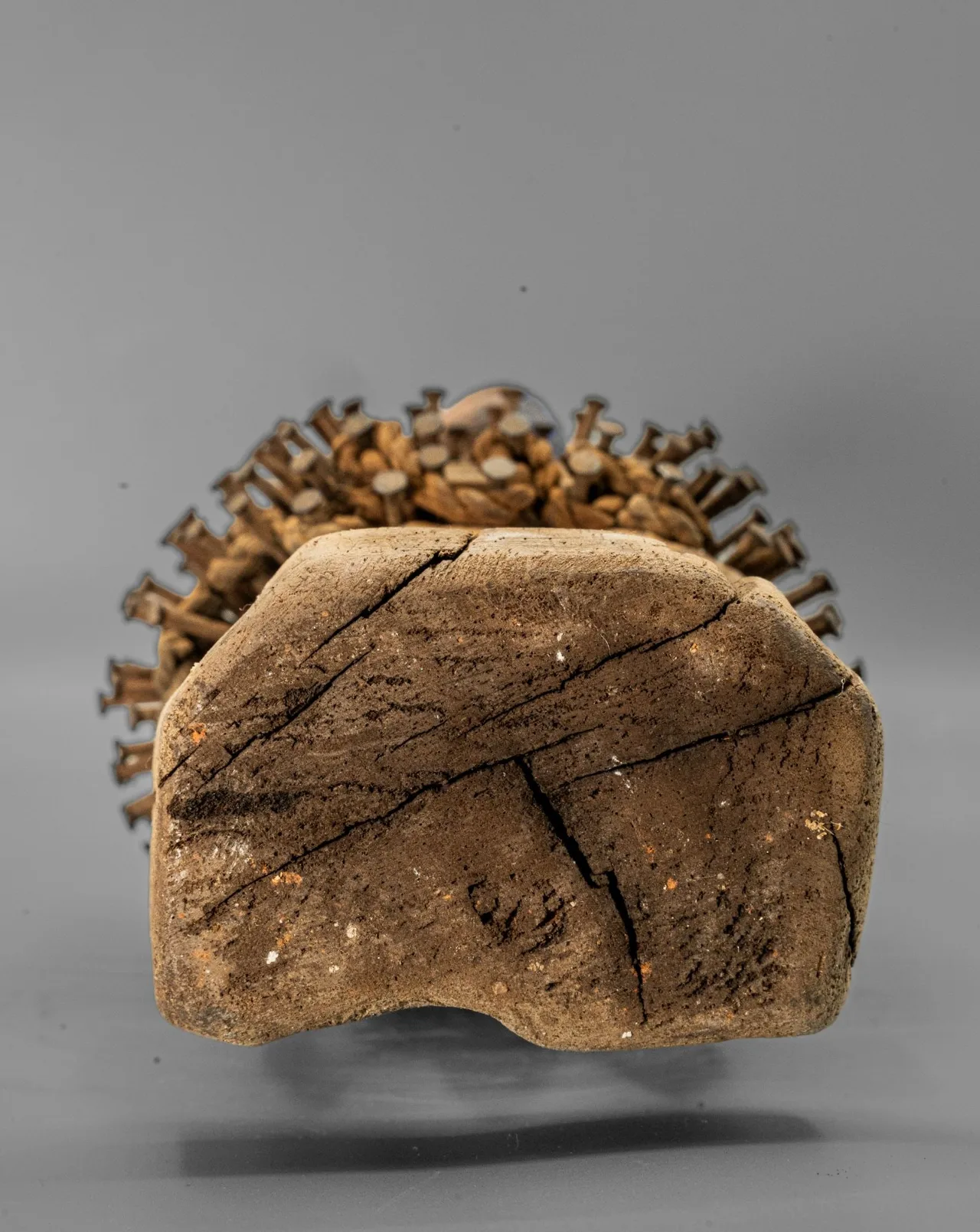
The split red and blue polychromy on the face is graphic and unusually striking. The legs are carved with a sturdy, grounded stance and a dark, polished surface that contrasts well with the textured torso. The nails and cord are arranged in rhythmic, almost radial order, giving a sculptural, tactile richness from every viewpoint. The figure stands on an integral block base, which gives it stability and a clear display line.
Yombe · Democratic Republic of the Congo

Yombe · Democratic Republic of the Congo

Yombe · Democratic Republic of the Congo

Yombe · Democratic Republic of the Congo

Yombe · Democratic Republic of the Congo

Yombe · Democratic Republic of the Congo