

Baule · Côte d’Ivoire
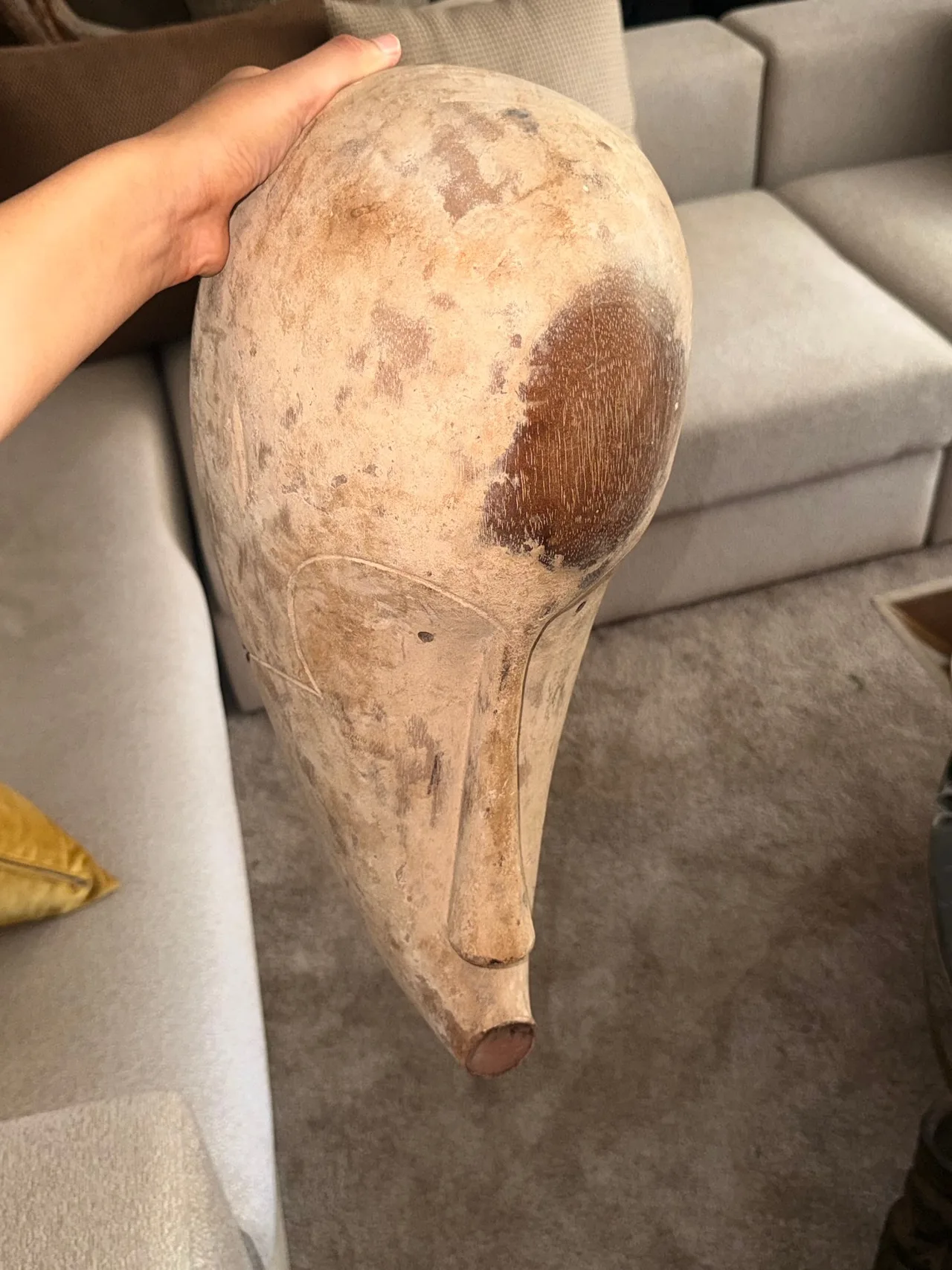
This is the interior/reverse side of a ceremonial face mask, showing the hollowed-out concave carving that would sit against the dancer's face. The visible wear patch, smoothed edges, and oxidized darkening from skin oils and sweat are strong physical indicators of authentic, repeated ceremonial use — a detail often used by appraisers to help distinguish genuinely danced masks from decorative reproductions.
The dark polished patch is not decorative — it's the clearest physical evidence on this piece that it was actually worn and danced, not made purely for the tourist/decorative market
The narrow, elongated silhouette tapering to a chin/mouth projection at the bottom matches the front-facing profile of Baule/Guro portrait or spirit masks
Small drilled holes along the edge (visible near the top) would have been used to attach raffia, fiber trim, or an attachment cord/headdress so the mask could be tied securely to the dancer's head
The light, weathered wood tone on the rest of the surface versus the dark contact patch shows differential aging — natural surface patina from air/handling versus polish from direct skin contact
As this is the unadorned reverse side, it lacks painted or carved decorative elements, but it offers valuable insight into the mask's authenticity and use-history — arguably more useful for verification purposes than the painted front, since forgeries/reproductions often fail to replicate this kind of naturalistic, asymmetrical wear pattern.
Baule · Côte d’Ivoire

Baule · Côte d’Ivoire

Baule · Côte d’Ivoire

Baule · Côte d’Ivoire

Punu · Gabon

Democratic Republic of the Congo