
Punu · Gabon
· Mid-20th century
| Dimensions | Height 45 cm (17¾ in) |
|---|---|
| Country | Gabon |
| Age / Period | Mid-20th century Mid-20th century, based on the heavy surface weathering, natural aging splits in the wood, and worn horn tips consistent with genuine ceremonial handling |
This piece belongs to a category of horned/animal-crested helmet masks used in powerful men's society or protective/aggressive ceremonial contexts — among the Baule, masks of this general form are associated with the Bonu Amuin tradition, danced during funerals of important men and to invoke strength, protection, and authority. Buffalo- or ram-horned masks more broadly across the region (Senufo, Guro) are linked to male initiation societies, bush-spirit power, and displays of physical/spiritual force.
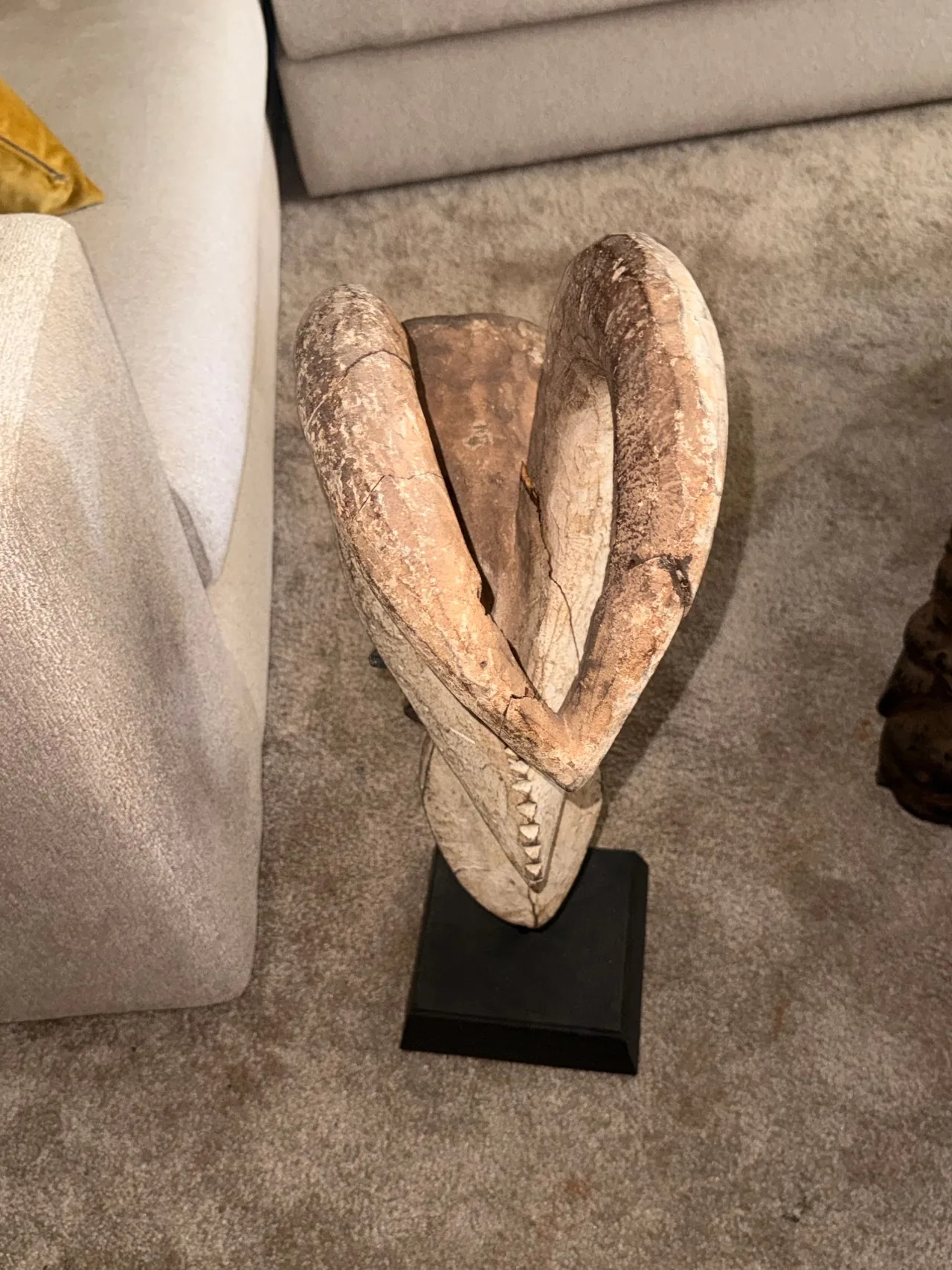
Large, sweeping curved horns forming a heart-like silhouette — horns are one of the most widespread symbols in West African masking traditions, representing raw power, virility, aggression, and a spiritual link to formidable bush animals such as buffalo, ram, or antelope
Deep central split at the horns' junction — largely a natural result of wood aging, though in many horned-mask traditions the negative space framed between the horns is also used compositionally, drawing the eye and heightening visual drama when the mask moves during performance
Triangular carved panel beneath the horns, edged with a notched/zigzag pattern — likely a stylized representation of teeth or a muzzle-like mouth, reinforcing the mask's fierce and protective character
Heavy, uniformly weathered bone-white surface — in contrast to more delicate, multicolored portrait masks, this stark and worn patina suggests a mask meant to project raw age, authority, and power rather than idealized human beauty
Non-naturalistic, fully abstracted form — situates this mask firmly within the "wild spirit" register of West African masking, as opposed to the calm, human-featured portrait tradition
This mask represents a markedly more aggressive and abstract mode of carving than the serene portrait-style masks often seen in Baule and Yaure work. Bold, sweeping curvature and the total absence of naturalistic human features emphasize force, danger, and spiritual potency rather than composure or refinement. Within the broader Baule/Guro/Senufo artistic spectrum, this piece exemplifies the "untamed power" register — the conceptual opposite of the quiet, idealized human portraiture typical of mblo-style masks.
Punu · Gabon

Democratic Republic of the Congo

Songye · Democratic Republic of the Congo

Songye · Democratic Republic of the Congo

Fang · Gabon

Baule · Côte d’Ivoire