
Punu · Gabon
Kuba · Mid-20th century
| Dimensions | Height 30 cm (11¾ in) |
|---|---|
| Country | Democratic Republic of the Congo Democratic Republic of Congo, Central Africa — another clear stylistic shift from the West African pieces earlier in your collection |
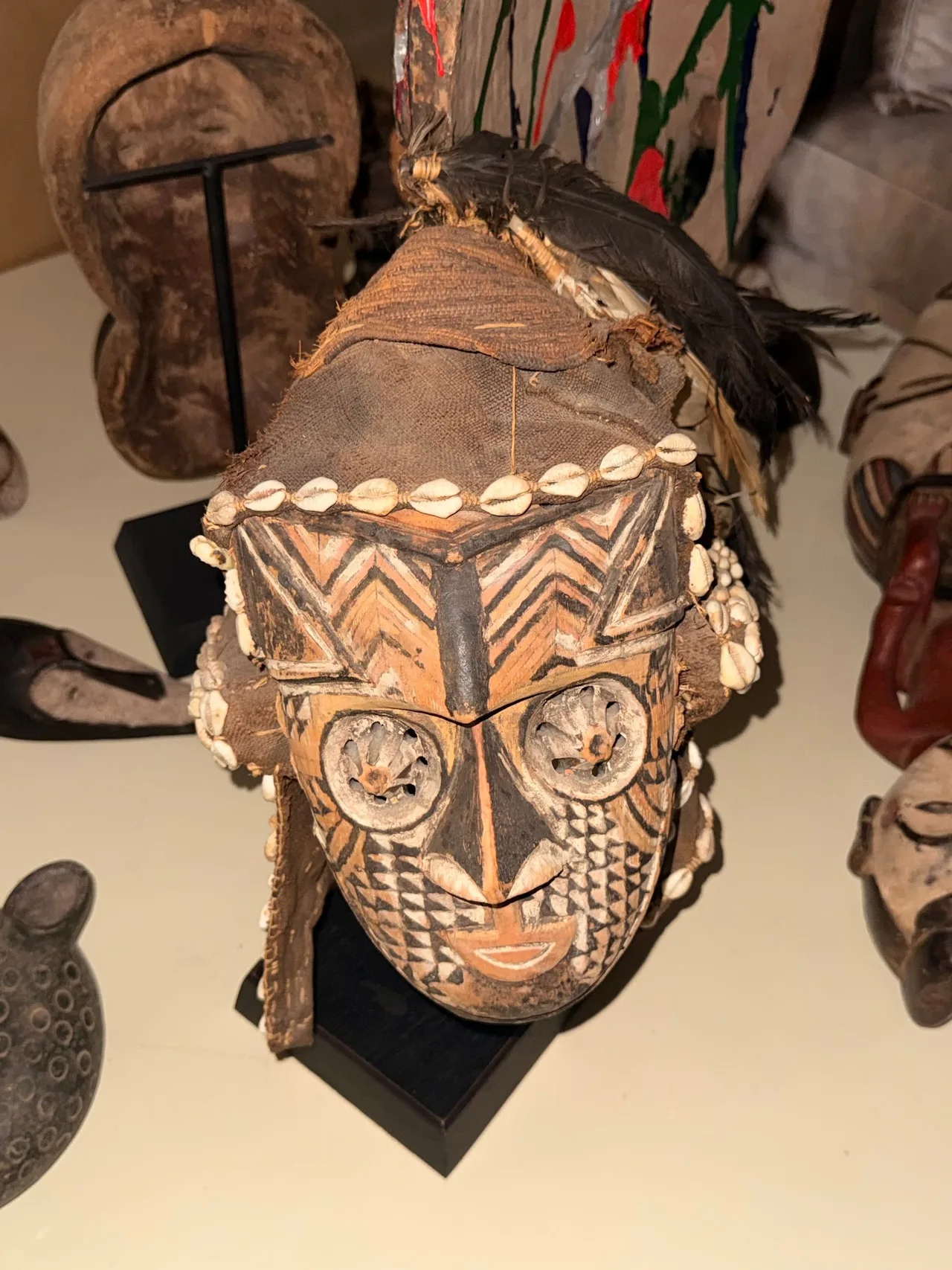
| Tribe / Culture | Kuba Kuba Kingdom (likely Kete or related Kuba-affiliated group) — the cowrie shell trim, geometric triangular/chevron polychrome patterning, cloth/raffia cap, and circular pierced eyes are highly characteristic of Kuba masking traditions |
| Age / Period | Mid-20th century Mid-20th century, based on the aged, worn cloth cap, oxidized cowrie shells, and paint loss consistent with genuine ceremonial use |
Kuba masks of this general type are worn in royal or court ceremonial contexts, and during initiation rites, funerals of titled individuals, or dances honoring lineage and political authority. The use of cowrie shells is especially significant — historically a form of currency and wealth in Central Africa, their presence on a mask visually communicates status, prosperity, and royal or elite association.
Cowrie shells stitched around the crown and face — a direct symbol of wealth, prestige, and royal/court status within the Kuba Kingdom, one of Central Africa's most hierarchically structured historical kingdoms
Circular, openwork pierced eyes with raised rims — create a striking, almost mechanical gaze; the "wheel-like" eye motif is a recognizable feature in several Kuba-related mask types, often meant to convey supernatural sight or otherworldly perception
Bold triangular/chevron geometric patterning across the brow and face — this dense, repeating geometric decoration is a hallmark of Kuba textile and mask design, reflecting a broader Kuba artistic philosophy where surface pattern itself carries prestige and visual sophistication
Woven cloth/raffia cap and black feather plume — soft-material elements attached directly to the wood face are typical of Kuba construction, where masks often combine carved wood with textile, fiber, and shell in a single composite object rather than wood alone
Vertical black nose ridge dividing the face symmetrically — anchors the composition and reinforces the mask's formal, balanced presentation
This mask reflects the distinctly different artistic language of the Kuba Kingdom compared to both the West African (Ivorian) and other Central African (Fang/Kwele) pieces in your collection. Where those traditions favor either naturalistic serenity or restrained geometric minimalism, Kuba masking embraces dense, layered ornamentation — combining carved geometric patterning, shell work, and textile into a single richly decorated composite object that visually communicates wealth, status, and courtly sophistication.
Punu · Gabon

Democratic Republic of the Congo

Songye · Democratic Republic of the Congo

Songye · Democratic Republic of the Congo

Fang · Gabon

Baule · Côte d’Ivoire