
Bakongo (Kongo) · République démocratique du Congo
Bakongo (Kongo) · 20th century.
| Pays | République démocratique du Congo |
|---|---|
| Tribu / Culture | Bakongo (Kongo) |
| Époque / Période | 20th century. |
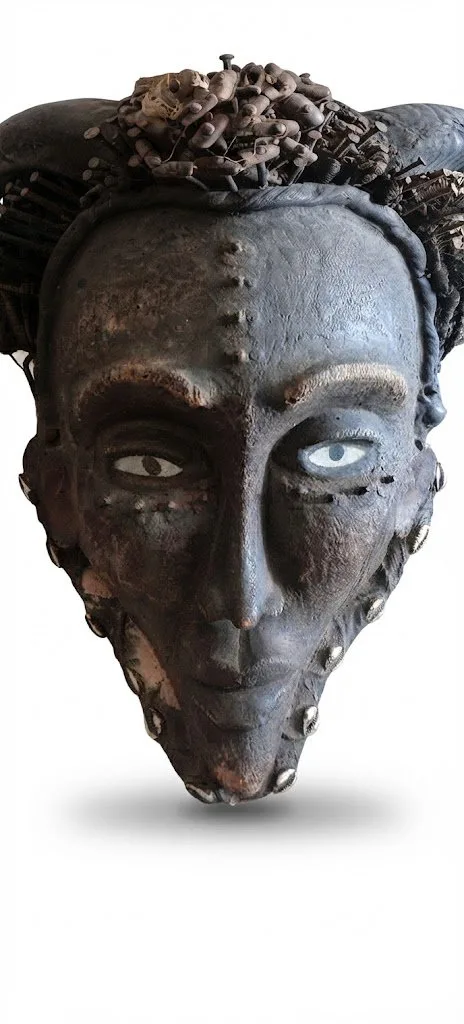
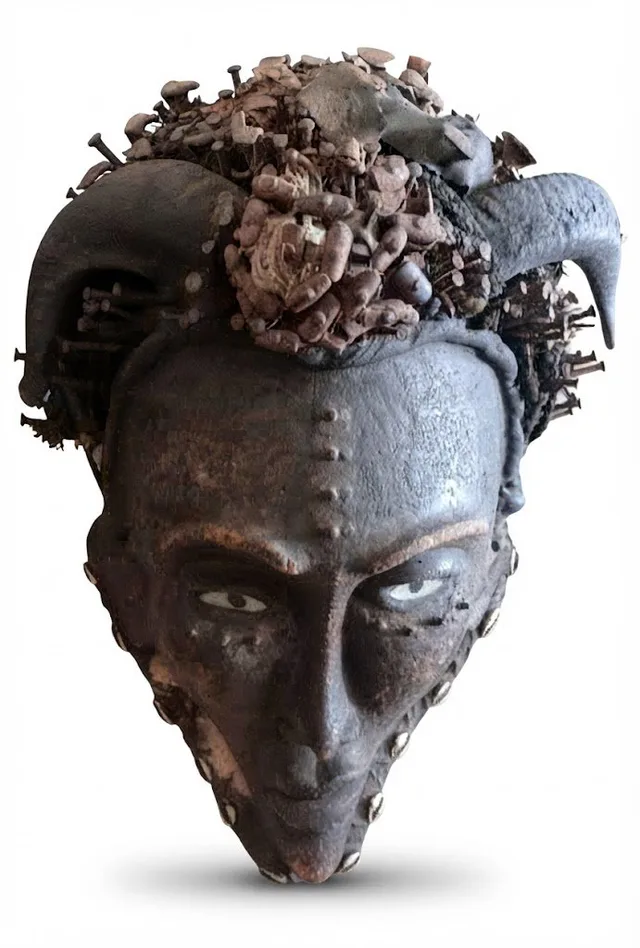
The mask joins a carved face to the materials of the nkisi. The two curved horns recall the animal horns that banganga packed with medicines and used as containers of power; they are emblems of concentrated, directed force. The crown is densely charged with iron nails and wooden pegs set among fibre and hide, each insertion marking an invocation, an oath or a call for protection.
Cowrie shells frame the face along the cheeks and jaw. They are symbols of wealth and, like mirrors and glass, can seal the medicines of a power object; they also evoke water, the boundary between the living and the dead. A line of studs runs down the centre of the brow, and studs beneath the eyes mark the face with the language of scarification. The white inset eyes carry second sight into the spirit world, and white pigment on the brows recalls mpemba.
A mask of considerable dramatic power. The tapering oval face narrows to a pointed chin and is carved with a long, straight nose, heavy lids and full, closed lips, in a deep, dark patina with warm reddish tones at the edges. The white eyes and pale brows give an intense, direct gaze, and the border of cowrie shells frames the face with a rhythmic, glinting line. Above, the crown becomes a dense mass of nails, pegs and fibre, flanked by two sweeping horns that give the mask a bold silhouette from every angle.
Bakongo (Kongo) · République démocratique du Congo

Bakongo (Kongo) · République démocratique du Congo

Bakongo (Kongo) · République démocratique du Congo

Yoruba · Nigeria

Punu · Gabon

République démocratique du Congo