
Yoruba · Nigeria
Guéré · Mid-20th century
| Dimensions | Hauteur 35 cm (13¾ in) |
|---|---|
| Pays | Côte d’Ivoire / Liberia Côte d'Ivoire (western region, near the Liberia border), West Africa |
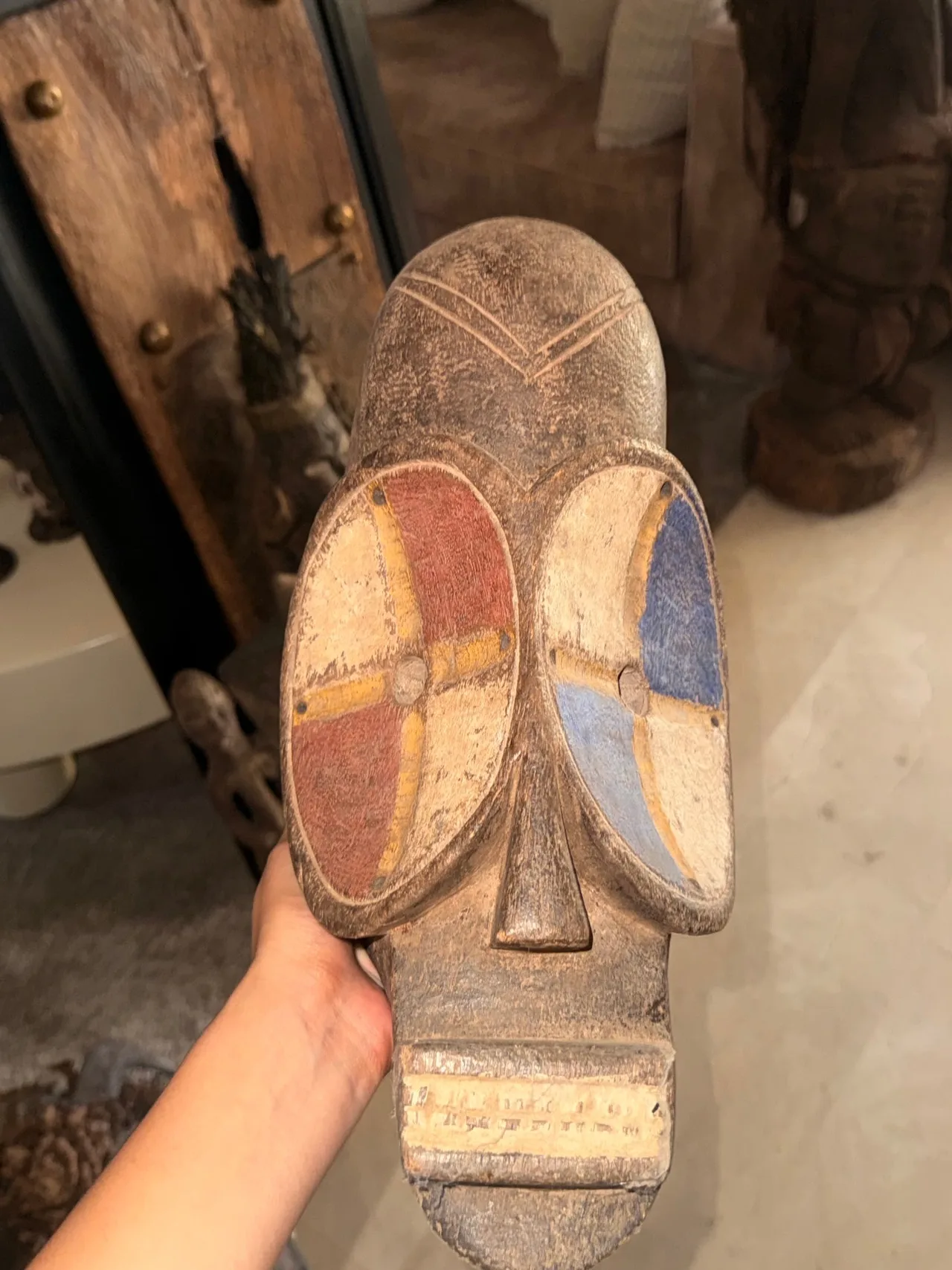
| Tribu / Culture | Guéré Likely Guéré (Wè) or Bété — these groups are known for bold, brightly painted masks with large protruding eyes and expressive, often intimidating features, distinct from the more restrained Baule style |
| Époque / Période | Mid-20th century Mid-20th century, based on the worn and faded pigment layers and smoothed carving surfaces consistent with genuine ceremonial handling |
Guéré/Wè masks are traditionally used in a wide range of ceremonial roles — including entertainment, protective/warrior functions, and spirit-invoking dances. Masks featuring large, dramatic eye discs like this one were often associated with heightened supernatural perception or power, and were danced during important community rituals, judicial proceedings, or celebrations.
Large, quartered circular eye discs painted in contrasting colors — the crosshair/quadrant pattern is a striking decorative device meant to intensify the sense of the mask's gaze and spiritual vigilance; the paired but differently colored eyes (red/yellow versus blue/yellow) may reflect a duality — day/night, male/female, or two opposing spiritual forces
Small raised bosses at the center of each eye disc — likely representing the pupil, adding a further layer of intensity to the mask's stare
Sharply triangular carved nose — a geometric, minimalist treatment typical of Guéré/Wè abstraction
Banded, tooth-like pattern carved along the lower jaw/chin area — suggests an open, grimacing or "toothy" mouth, a common feature in Guéré masking meant to project power, ferocity, or spiritual authority
Bold primary-color palette — the use of vivid red, blue, and ochre stands in sharp contrast to the more subdued, naturalistic tones of the Baule masks in your collection, reflecting a different regional aesthetic that favors high visual drama
This mask is a striking departure from the calm, idealized human portraiture of the Baule tradition. Its oversized, brightly patterned eyes and grimacing lower jaw create a bold, almost confrontational visual presence — characteristic of the Guéré/Wè approach to masking, which emphasizes raw expressive power and spiritual intensity over serene naturalism.
Yoruba · Nigeria

Punu · Gabon

République démocratique du Congo

Songye · République démocratique du Congo

Songye · République démocratique du Congo

Fang · Gabon