
Bakongo (Kongo) · Democratic Republic of the Congo
Bakongo (Kongo) · Mid-20th century (c. 1930–1970), provisional.
| Dimensions | Height 65 cm (25⅝ in)Width 20 cm (7⅞ in)Depth 19 cm (7½ in) |
|---|---|
| Country | Democratic Republic of the Congo |
| Tribe / Culture | Bakongo (Kongo) |
| Age / Period | Mid-20th century (c. 1930–1970), provisional. |
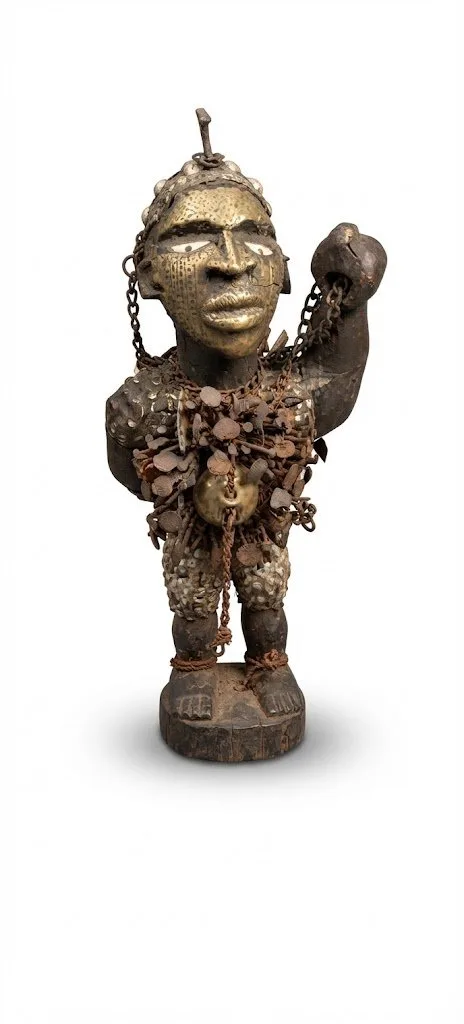
The figure takes the aggressive nkondi pose, one arm raised in challenge and vigilance. The metal-sheathed cap is topped by a single large nail, and a chain runs from the head down to the raised hand. Nails, blades and links gather across the torso, each recording an oath, a dispute or a plea. The face is incised with lines and dots that refer to scarification, and the white-accented eyes signal vision into the spirit world.
The rounded capsule on the abdomen, set with a gilt-toned disc, marks the seat of the bilongo. The figure stands on an inverted second head, an unusual device that extends the ritual programme.
A bold and theatrical work. The luminous, gilt-toned face with its fine incisions, the corroded iron of the torso and the silvery, studded legs create strong contrasts of colour and texture, while the dark wooden arm and the black head below act as sombre counterweights. The draped chain adds movement, and the reflective metal catches the light against the dark patina.
Note. Metal sheathing on the face and body is not a standard Kongo convention and recalls the hammered brass facial panels of Songye power figures. The figure belongs to a later phase in which the language of the classic tradition was reinterpreted with new materials; the attribution is provisional.
Bakongo (Kongo) · Democratic Republic of the Congo

Bakongo (Kongo) · Democratic Republic of the Congo

Bakongo (Kongo) · Democratic Republic of the Congo

Yoruba · Nigeria

Yombe · Democratic Republic of the Congo

Yombe · Democratic Republic of the Congo