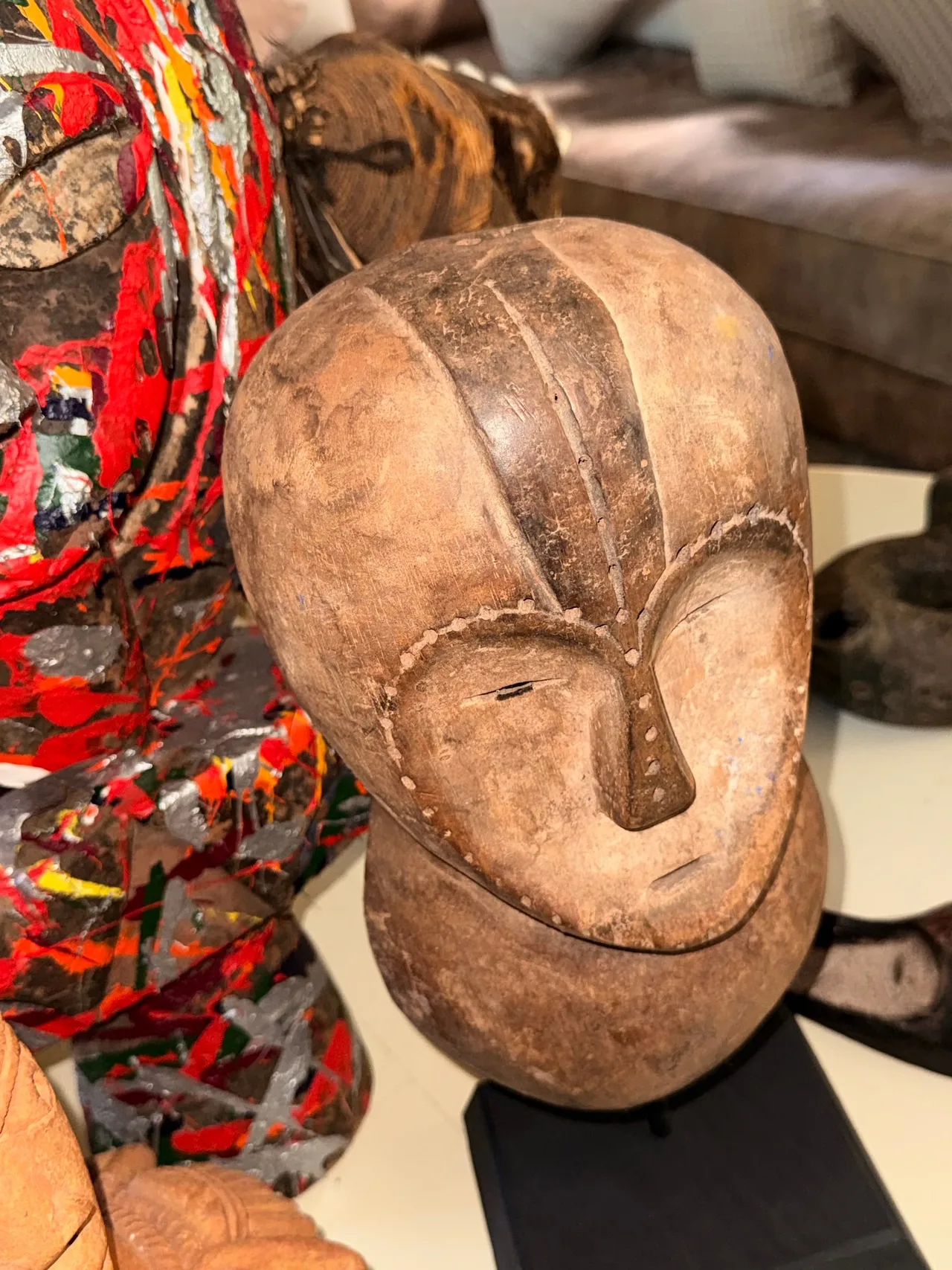

Fang · Gabon
Fang · Mid-20th century
| Dimensions | Hauteur 30 cm (11¾ in) |
|---|---|
| Pays | République du Congo / Gabon / Côte d’Ivoire Gabon or Republic of Congo, Central Africa — this represents a stylistic shift from the West African (Ivory Coast) pieces earlier in your collection Gabon / Republic of the Congo (Central Africa) |
| Tribu / Culture | Fang Likely Fang or Kwele — the elongated heart-shaped face, high vertical forehead ridge, dotted linear borders, and closed, meditative slit eyes are hallmark features of these Central African carving traditions Kwele or Fang peoples |
| Époque / Période | Mid-20th century Mid-20th century, based on the smoothed, aged patina and worn surface consistent with genuine handling; heavier wear on raised areas (nose ridge, brow) suggests years of touching or ritual use Mid-20th century (circa 1930s–1950s) |
Masks of this type across Fang and Kwele traditions were used in a variety of ceremonial roles — including judicial/legal proceedings, initiation rites, and spirit-invoking dances meant to convey calm authority, moral judgment, or ancestral wisdom. The serene, closed-eye expression is often associated with a state of trance, spiritual transcendence, or communion with the ancestral/spirit world.
Prominent vertical keel ridge running from the forehead down through the nose — a defining structural feature in Fang/Kwele masks, dividing the face symmetrically and reinforcing a sense of calm, ordered balance
Narrow, closed or nearly-closed slit eyes — convey introspection, spiritual trance, or communion with unseen forces rather than active human engagement; this expression is central to the serene, otherworldly quality prized in these traditions
Dotted linear border along the brow and jaw — decorative stippling often used to frame the face and separate it visually from the surrounding wood, a refined touch found in higher-quality carvings
Heart-shaped facial silhouette with a high domed forehead tapering to a narrow chin — the broader, rounded head form and pointed lower face are characteristic of both Fang and Kwele aesthetic ideals
Overall pale, smooth wood tone — echoes the broader Central African preference (seen strongly in Fang Ngil-society masks) for light-colored, luminous surfaces associated with spirits, ancestors, and the moral authority of the mask's role
The closed, downcast eyes represent introspection, profound calm, and communion with the ancestral realm. The prominent tall coiffure and stylized side crests symbolize spiritual elevation, high social rank, and protection over the community.
This mask marks a clear stylistic departure from the Ivorian (Baule/Guro/Grebo) masks in the rest of your collection, moving instead into the refined, geometric minimalism of Central African Fang/Kwele carving. Its restrained, symmetrical composition and inward, meditative expression stand in contrast to the more theatrical, brightly painted West African pieces — reflecting a different regional philosophy where stillness and moral gravity, rather than dramatic ornamentation, convey spiritual power
TDimension: Approximately 38 cm (15 inches) in height
Characterized by a rich, weathered dark wood patina, balanced facial symmetry, sweeping brow lines, stylized side horns framing the face, and subtle traces of white kaolin accentuating the lower jawline.
Fang · Gabon

Fang · Gabon

Fang · Gabon

Fang · République démocratique du Congo

Fang · République démocratique du Congo

Yoruba · Nigeria